Launching your career as a Nurse Practitioner (NP) or Physician Assistant (PA) includes more than just earning a degree and passing boards. You must complete a structured process that moves from state licensing to hospital privileges to practice in a hospital. This guide breaks down PA and NP hospital credentialing requirements, timelines, and how the process differs from physicians, so you can move from licensed to hospital-ready with confidence.
Why NP/PA Credentialing Differs from MDs
Although NPs and PAs are advanced practice providers (APPs), their credentialing pathways differ from those of physicians (MDs/DOs).
Key Differences:
- Scope of Practice
- MDs practice independently in all states.
- NPs may have full, reduced, or restricted practice depending on state law.
- PAs practice under physician supervision (state dependent).
- Licensure vs Certification
- Physicians complete residency and board certification before full privileges.
- NPs require graduate education and national certification (e.g., AANP/ANCC).
- PAs need graduation from an accredited PA program and NCCPA certification.
- Hospital Privileging Authority
- Hospitals determine what procedures NPs and PAs can perform.
- Privileges are often tied to collaborative agreements (for PAs and some NPs).
Hospital credentialing committees review NP/PA applications more closely for compliance with state laws because the APP scope varies by state.
NP Hospital Credentialing Requirements
You must complete the following before receiving NP hospital privileges:
NP Hospital Privileges Checklist
Active state RN license
Active state NP/APRN license
National board certification (AANP or ANCC)
DEA registration (if prescribing controlled substances)
Collaborative agreement (if required by state)
Malpractice insurance
Work history and references
Background check
Immunization & health records
Hospitals verify education, certification, training, and malpractice history before granting advanced practice hospital privileges.
Nurse Practitioner Credentialing Timeline
Typical timeline:
- State license: 2 to 8 weeks
- DEA registration: 2 to 6 weeks
- Hospital credentialing review: 60 to 120 days
Delays occur because of incomplete documentation or verification backlogs.
Related resource: How Licensing Relies on Credentialing
PA Privileging Process and State Licensing
The PA hospital privileging process involves both national certification and state licensure.
PA Hospital Privileging Requirements
Graduation from an ARC-PA-accredited program
NCCPA certification (PANCE exam)
Active state PA license
Supervising physician agreement
DEA registration (if prescribing)
Work history verification
Procedure competency documentation
NCCPA vs State PA License
NCCPA certification proves national competency.
A state license grants legal authority to practice in a specific state.
Both are required before hospital credentialing begins.
PA Multi-State Credentialing
Traveling PAs or those working across health systems must:
Maintain multiple state licenses
Meet each hospital’s credentialing standards
Renew privileges separately per facility
Related resource: How to Do Hospital Credentialing
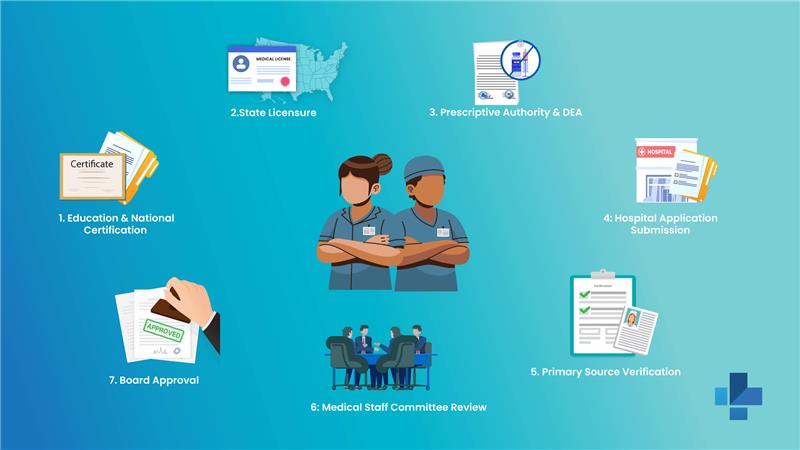
Step-by-Step Credentialing Timeline for NPs/PAs
Understanding the process helps avoid delays.
Step 1: Education & National Certification
- NP: Graduate program + AANP/ANCC certification
- PA: Accredited program + NCCPA certification
Step 2: State Licensure
Apply through the state medical or nursing board.
Step 3: Prescriptive Authority & DEA
Apply for controlled substance authority if required.
Step 4: Hospital Application Submission
Submit:
- License verification
- Certification verification
- CV & references
- Malpractice history
Step 5: Primary Source Verification
The hospital verifies all credentials directly with issuing organizations.
Step 6: Medical Staff Committee Review
The credentials committee evaluates scope and competency.
Step 7: Board Approval
Final approval grants advanced practice hospital privileges.
Total NP/PA credentialing timeline: 60 to 120 days (average)
Related resource: Three Types of Credentialing
medtigo’s NP/PA Credentialing Services
Credentialing can be complex, specifically when balancing licensing, DEA registration, and hospital onboarding.
With medtigo advanced practice licensing, we help you:
Secure state licenses
Manage DEA applications
Coordinate multi-state credentialing
Track expiring credentials
Submit hospital privilege applications
Reduce credentialing delays
From licensing to hospital-ready, we have got you.
Launch Your Advanced Practice Career
Already registered? Login →
Questions? support@medtigo.com
FAQs
1. Can NPs get full admitting privileges without MD supervision?
In full practice authority states, yes. However, hospital policy ultimately determines admitting privileges.
2. What is NCCPA verification vs state PA license?
NCCPA certification verifies national competency. A state license grants legal authority to practice in that state.
3. Is the PA scope limited by the supervising physician?
In most states, yes. Scope is defined by state law and supervising physician agreements.
4. NP prescriptive authority during credentialing?
NPs may prescribe once state authority and DEA registration are active, but hospital prescribing privileges require credentialing approval.
5. Multi-hospital privileges for traveling NPs?
Yes, but each hospital requires a separate credentialing process.
6. Re-credentialing cycle for NPs/PAs?
Most hospitals require re-credentialing every 2 years, which includes updated licenses, certifications, and competency reviews.