Locum tenens work provides flexibility, increased income potential, and exposure to different clinical settings, but only if you can clear credentialing efficiently. Any delays in the locum tenens credentialing process are the biggest barrier to starting assignments on time for many providers.
This guide walks you through the process of credentialing for locum physicians step by step, explains needed documentation, highlights common pitfalls, and shows how centralized tools like medtigo Connect simplify the entire journey.
Related reading: types of credentialing
The Locum Credentialing Process
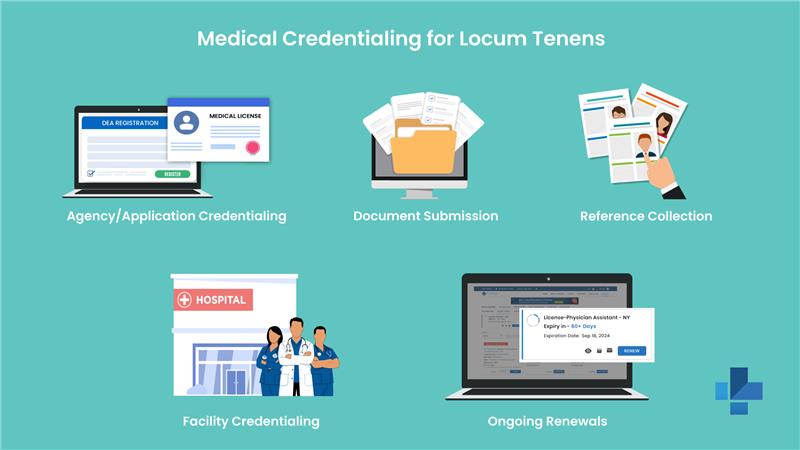
Understanding locum tenens credentialing steps helps you to plan realistically and decreases your locum credentialing timeline. While timelines can vary by facility, most follow the same five-stage framework.
Internal reference: detailed PSV process
Step 1: Agency/Application Credentialing
They perform core Primary Source Verification (PSV) to establish baseline eligibility before the staffing agency can present you to the facility.
This typically includes verification of:
Active medical licenses
DEA registration
Medical education and training
Agency approval is the gatekeeper; without it, facility credentialing cannot begin.
Step 2: Document Submission
Once it is approved by an agency, you will submit a standardized credentialing packet. Commonly needed documents involve:
Updated CV
State licenses
Board certifications
Immunization records
Accuracy and completeness directly impact turnaround time.
Step 3: Reference Collection
Most facilities require:
Three specialty-specific peer references
One program director or supervising physician reference (for recent graduates)
Pre-collecting references dramatically reduces delays later in the process.
Step 4: Facility Credentialing
Each hospital or clinic performs its own credentialing, which includes:
Facility-specific PSV
Privileging based on the scope of practice
Medical staff committee approval
Even if you have worked at the facility before, re-verification is required.
Step 5: Ongoing Renewals
Credentialing does not stop once you are approved.
Many facilities follow a “see patient = stay credentialed” rule, which means:
Active clinical work maintains privileges
Gaps in assignments may trigger re-credentialing
Tracking expirations is essential to avoid sudden interruptions.
medtigo Connect: “Track all 5 steps in one dashboard.”
Required Documents Checklist
Having documents ready before agencies request them is one of the fastest ways to streamline locum tenens for credentialing documents and meet locum PSV requirements.
Core Documents
Licenses
- Active primary state license
- Additional IMLC state licenses
DEA Certificate
- Current DEA registration
- Full DEA history (if applicable)
Board Certifications
- Initial certification
- Maintenance of certification (MOC) records
Malpractice History
- Claims history
- Tail coverage proof
Immunizations
- MMR
- Hepatitis B
- TB test (recent)
Life Support Certifications
- ACLS
- PALS
- BLS
Pro Tip: Scan and upload everything in Connect before an agency asks. Speed starts with preparation.
Multi-State Licensing Strategy for Locums
For providers working across regions, multi-state locum credentialing is a game-changer.
Related reading: hospital credentialing steps
IMLC Advantage
The Interstate Medical Licensure Compact (IMLC) allows physicians to apply once and obtain licenses in 42 participating states, significantly reducing administrative burden.
Tiered Licensing Approach
Start assignments in states where you are already licensed while additional licenses are being processed.
Expedited License States
Some states offer licenses in as little as 30 days (e.g., Oklahoma), making them ideal for rapid placements.
Connect Tracking
medtigo Connect maintains a multi-state renewal calendar that helps you avoid lapses across jurisdictions.
Provider Pitfalls to Avoid
Avoiding common locum credentialing mistakes is one of the easiest ways to speed up locum credentialing.
Frequent Errors
- CV timeline gaps → Document all employment breaks
- Inconsistent disclosures → Answer all “YES/NO” questions identically across applications
- Expired supporting documents → An expired ACLS can restart credentialing entirely
- Slow references → Pre-collect reference letters from supervisors
- Facility-specific applications → Store completed forms in Connect for reuse
medtigo Connect for Locums
medtigo Connect is a dedicated locum credentialing platform designed to:
- Store PSV-ready documents
- Track agency and facility applications
- Monitor expirations and renewals
- Share credentialing packets securely with staffing agencies
For providers managing multiple assignments, Connect becomes a single source of truth.
FAQs
1. Can I see patients before full credentialing?
In most cases, no, facilities require full credentialing and privileging before patient contact, with rare exceptions for supervised or emergency coverage.
2. How often do facilities re-credential locums?
Typically, every 6 to 12 months or after extended gaps between assignments.
3. Does Connect work with staffing agencies?
Yes, Connect is designed to integrate seamlessly with agency workflows and credentialing teams.
4. What if my DEA lapses mid-assignment?
Most facilities will suspend privileges immediately until the DEA is renewed and re-verified.
Conclusion:
Start Your Locum Credentialing Journey
Successful locum tenens careers are built on fast, accurate, and repeatable credentialing. With the right strategy and the right tools, you can reduce delays, expand your opportunities, and stay assignment-ready year-round.
Build a Locum Portfolio with medtigo Connect
For personalized locum credentialing strategies, contact support@medtigo.com