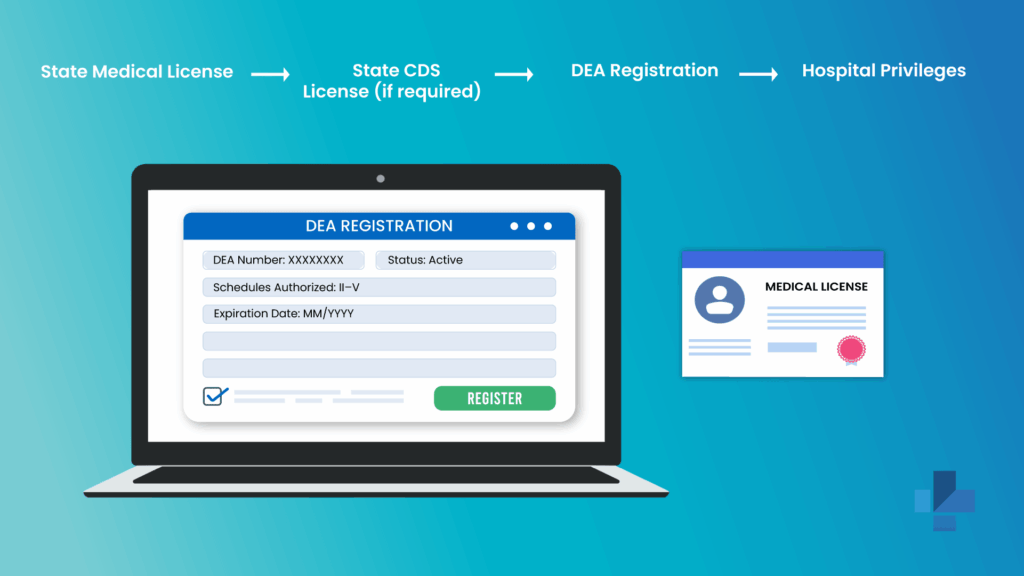
Obtaining hospital privileges includes navigating a complex regulatory landscape that combines state medical licensing with DEA registration for controlled substances. For physicians and advanced practice providers, it is important to understand the sequence, requirements, and synchronization of these credentials to practice safely, legally, and without interruption.
Section 1: State Licensing Foundations
Providers must secure a state medical license, which grants authority to prescribe and administer controlled substances, before pursuing DEA registration. Key points are:
Controlled Substance (CS) Designation: States assign schedules (II-V) to medications, which determine prescribing privileges. Your license must clearly indicate the CS level you are authorized to handle.
Education Requirements: Many states require opioid or controlled substance training as part of licensing or renewal. Completing these ensures compliance with state law and federal DEA expectations.
Timing Matters: The DEA requires that you hold an active state license before applying for registration, making state licensure the first step in the process.
Section 2: DEA Registration
Once your state license is in hand, DEA registration enables you to prescribe, administer, and dispense controlled substances. Key considerations are:
Form 224: Hospitals and institutional providers use DEA Form 224 to apply for registration. Individual practitioners use the same form but follow a slightly different submission process.
Timeline: Processing can take 2 to 6 weeks on the basis of the DEA workload and state verification. Early application ensures uninterrupted prescribing privileges.
Renewals: DEA registration is valid for 3 years. Timely renewal prevents gaps in your ability to prescribe controlled substances.
Section 3: Synchronization Challenges
Maintaining compliance at the state and federal levels can be complicated:
Expiration Misalignment: State licenses and DEA registrations often have different expiration dates, risking gaps if renewals are not tracked.
Interstate Variations: Some states (like New York or Massachusetts) require additional Controlled Dangerous Substances (CDS) licenses beyond a DEA number.
Multi-State Practice: Practicing in multiple states requires separate DEA registrations or CDS licenses, which create potential compliance pitfalls if timelines are not coordinated.
Section 4: medtigo Streamlined Approach
Platforms like medtigo simplify state and DEA credential management and allow providers to focus on patient care instead of administrative hurdles:
Unified Tracking Dashboard: Monitor all state and DEA licenses in one place.
Proactive Renewals: Automated alerts help you renew licenses before they expire, preventing lapses.
Compliance Documentation: Easily generate and share proof of licensure for hospitals, insurers, or regulatory audits.
Go and visit Secure DEA + State Licensing
Streamline your hospital privileges and controlled substance compliance today. Ensure your state medical license, DEA registration, and any CDS licenses are tracked and renewed proactively to maintain uninterrupted practice.
FAQs
1. Can I apply for DEA registration before obtaining my state medical license?
No, DEA registration requires an active state license as a prerequisite.
2. What happens if my DEA registration expires while my state license is still active?
You cannot legally prescribe controlled substances until your DEA registration is renewed, even if your state license is valid.
3. How much does a DEA registration cost for different providers?
Fees may vary, typically $888 for physicians and $584 for mid-level practitioners, valid for three years.
4. Do I need separate DEA numbers for multi-state practice?
Not always are federal DEA numbers valid nationwide, but some states require additional CDS registrations to prescribe locally.
5. Which states require additional CDS licenses beyond the DEA?
States like New York, Massachusetts, and Florida mandate separate CDS licensure for certain schedules.
6. How often do hospitals verify the DEA during credentialing?
Hospitals typically verify DEA and state licenses during initial credentialing and annual re-credentialing to maintain compliance.